How to Play Padel?
The 2026 Ultimate Guide
Rules, court dimensions, equipment, and technique. Everything you need to know about the world's fastest-growing sport.
Introduction & Origins
Many beginners ask themselves: How to play padel? It is the sociological phenomenon of the 21st century, combining the dynamics of tennis with the geometry of squash. The last decade has brought unprecedented professionalization to this discipline.
The content below constitutes a complete collection of technical, legal, and organizational knowledge for players, investors, and coaches. You will learn not only how to play, but also how the court is built and what rules govern the world Tour.
History of the Discipline
Mexico, Acapulco: Enrique Corcuera adapts a court into a fronton by enclosing it with walls. The birth of the discipline.
Spain, Marbella: Alfonso de Hohenlohe builds the first courts in Europe. Spain and Argentina become incubators of development.
Argentina: Padel reaches the status of the second most popular discipline after football.
Poland, Warsaw: The first fully professional padel club is established, marking a new era in Central Europe.
Technical Infrastructure
Unlike tennis, in padel, the fence and walls are active elements of the game. Understanding the court structure is key to knowing how to play padel correctly.
Vertical Dimensions (Walls)
The rear walls have a total height of 4m (3m tempered glass + 1m mesh). Glass (10-12mm thick) is mounted on neoprene pads to absorb vibrations. The mesh wire diameter is 1.6-3mm (openings 4-5cm) to prevent the ball from getting stuck.
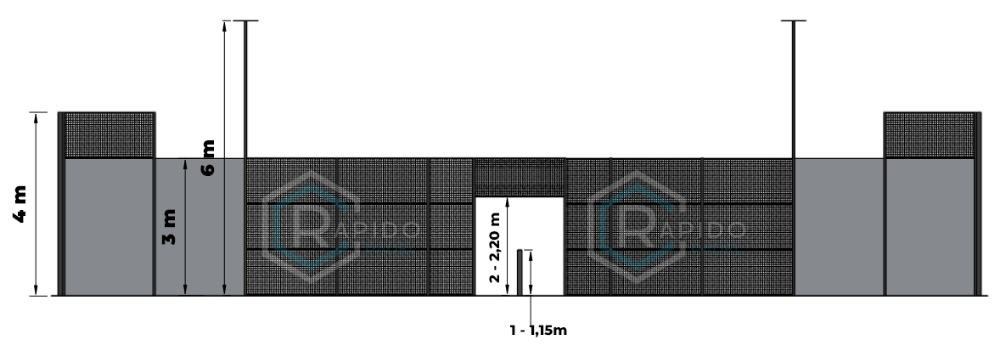
Court Dimensions
The official court dimension is a rectangle of 20m x 10m. Service lines are located 6.95 m from the net. Dimensional precision (tolerance ±0.5% or approx. 10 cm) is crucial for ball rebound geometry.
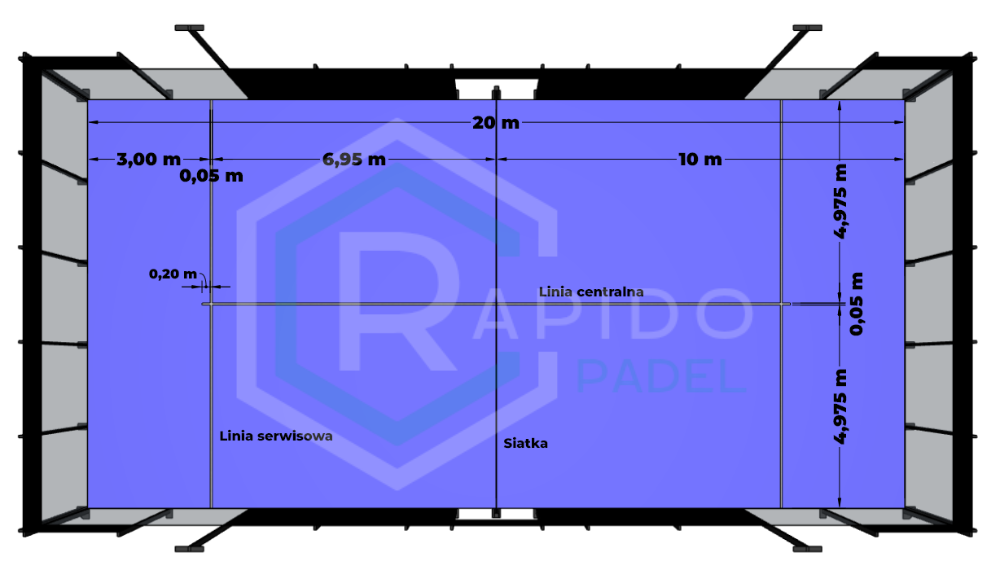
The Net
The net height is 0.88 m at the center and 0.92 m at the posts. This element is precisely regulated by FIP standards.
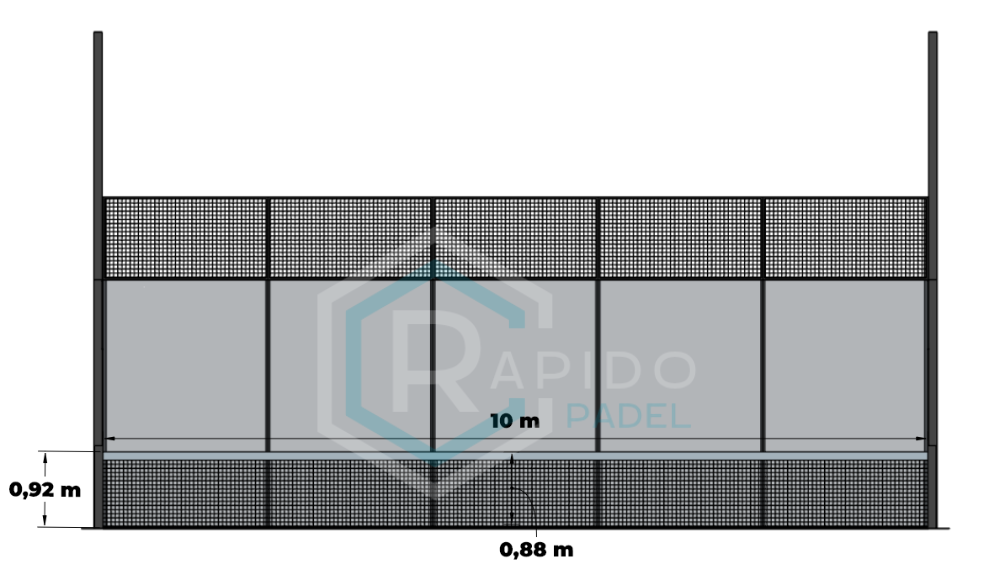
Hall Height
For indoor facilities, ceiling height is key. The minimum is 6 meters, but 8 meters is recommended for new halls to allow high lobs. LED lighting must be positioned outside the playing area.
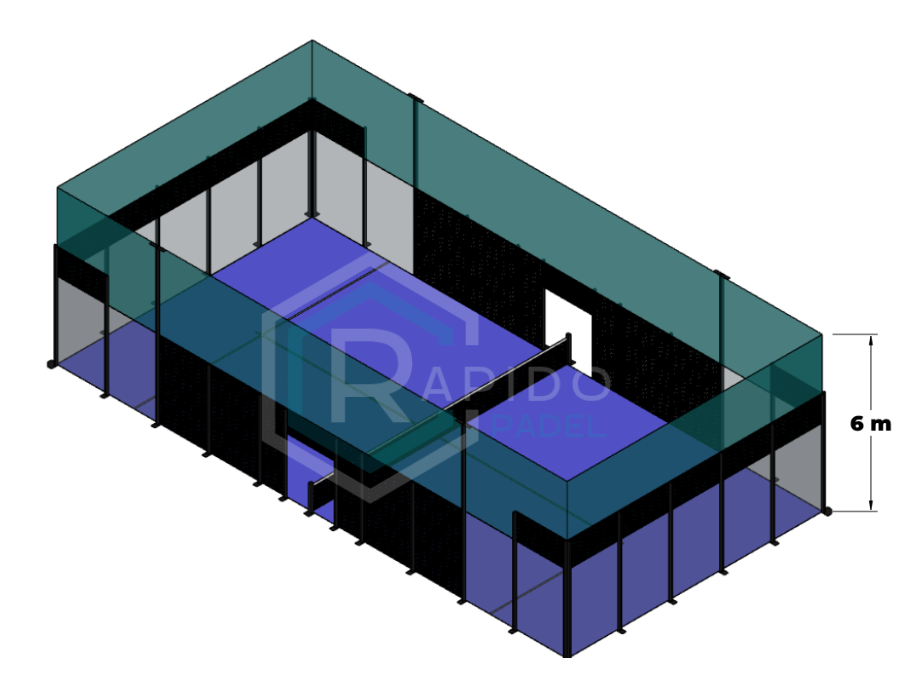
Technical Parameters (According to FIP)
| Element | Dimensions / Specification | Technical Notes |
|---|---|---|
| Play Area | 20.00 m x 10.00 m | ±0.5% (internal dimensions) |
| Rear Wall | 4.00 m | 3 m glass + 1 m mesh |
| Glass | 10-12 mm | Tempered (EN 12150-1), mounted on neoprene |
| Safety Zone | 3 m x 8 m (per side) | Required for outdoor play |
How to play Padel? Rules
Service Procedure
To start the game correctly, the service is always performed "underhand".
- Height: Contact with the ball at waist height or below. Exceeding this is a fault.
- Bounce: The ball must bounce behind the service line before being hit.
- Foot Fault: No jumping allowed, both feet must be behind the service line (not stepping on it).
- Side Mesh: If the ball hits the side fence after a valid service and bounce in the opponent's box - it is a fault.
- In-Play: Ball remains in play until the second bounce. Touching the net with body or racket is a lost point.
Scoring Systems
-
⭐ Star Point (New FIP Rule):
Alternative recognized by FIP. At 40:40, play up to max 3 deuces. If still tied, one decisive point is played. -
🎾 Advantage (Traditional):
Classic system. At 40:40 (Deuce), you need to win two consecutive points ("Advantage" -> "Game"). -
🟡 Golden Point (Punto de Oro):
At 40:40, no advantages – one decisive point is played. Receivers choose the side.
Equipment & Homologation
Racket (Pala)
It has no strings, but a solid perforated surface. Max thickness is 38 mm, length 45.5 cm.
Materials: Fiberglass (beginners), Carbon Fiber (3K/12K/18K - advanced). Core is usually EVA Soft (control) or EVA Hard (power).
Important: Every racket must have a safety strap. Playing without it is forbidden.

Ball
Lower pressure than tennis (4.6-5.2 kg). Bounce from 2.54m is 135-145 cm. Slower balls make learning how to play padel easier.
How to play efficiently? Technique
Continental Grip ("Hammer"): The foundation allowing you to handle 90% of situations without changing grip.
Bandeja ("Tray")
- Goal: Keep position at the net after a lob.
- Technique: Hit from head level, slice rotation. Low bounce.
Vibora ("Viper")
- Goal: Aggressive finish.
- Technique: Strong side spin. Ball "crawls" on the wall.
Bajada de Pared
- Goal: Offensive "wall exit".
- Situation: Hard hit from top to bottom after a high bounce off the glass.
Chiquita ("Small one")
Subtle, slow play at the opponent's feet. Forces a pop-up volley.
Globo ("Lob")
A basic tactical tool to gain ground. Must be played very high.
Tournament Systems
Now you know how to play, discover popular tournament formats.
Americano
Format amateur & semi-pro. Individual format, everyone plays everyone. Points for every ball won. Great for integration.
Mexicano
Algorithm pairs players close in ranking. Matches become more even each round.
Polako
Polish innovation (LigaPadla). Group phase with random partners + Knockout phase with picked partners.
Professional Padel World
Polish Padel Federation (PFP)
License Revolution: Automated licensing since 2025 removes entry barriers for amateurs.
International Padel Federation (FIP)
Premier Padel: The main professional circuit created under the aegis of FIP after WPT acquisition.
Official PFP Rankings
Classification lists are the basis for seeding in National Championships:
- Open (Men): Top category (e.g., Jerzy Janowicz).
- Women: Separate ranking for ladies.
- Juniors (U12-U18): Future stars (e.g., Tadeusz Janus).
FIP World Ranking
Official points system based on Premier Padel and Cupra FIP Tour tournaments:
- Major: 2000 pts (Grand Slam equivalent).
- P1 / P2: 1000 / 500 pts.
- Tour Finals: For top 8 pairs (Barcelona).
Olympic Future
Goal: Brisbane 2032
Padel is entering the final stretch to becoming an Olympic sport. After Paris 2024 and LA 2028, the Brisbane 2032 Games are the official target. Thanks to initiatives like the "Pacific Cup 2025", federations are pressuring the IOC to include Padel.
Summary
We hope this guide clarified how to play padel and encouraged you to hit the court. It's a sport entering maturity, offering a coherent ecosystem from amateur to global star.